
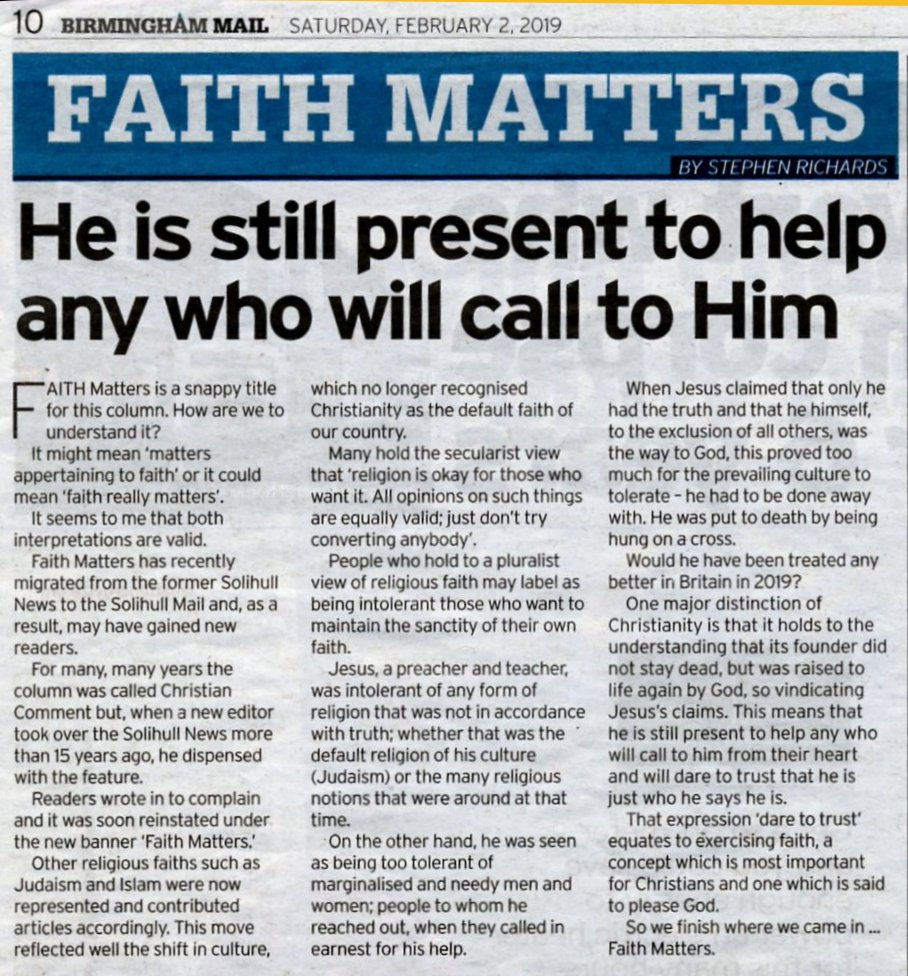
Faith Matters is a snappy title for this column. How are we to understand it? It might mean ‘matters appertaining to faith’ or it could mean ‘faith really matters’. It seems to me that both interpretations are valid.
Faith Matters has recently migrated from the former Solihull News to the Solihull Mail and, as a result, may have gained new readers. For many, many years the column was called Christian Comment but, when a new editor took over the Solihull News more than 15 years ago, he dispensed with the feature. Readers wrote in complaining and it was soon reinstated under the new banner ‘Faith Matters.’ Other religious faiths such as the Jewish and Islamic were now represented and contributed articles accordingly. This move reflected well the shift in culture, which no longer recognised Christianity as the default faith of our country.
Many hold the secularist view that, ‘religion is okay for those who want it. All opinions on such things are equally valid; just don’t try converting anybody.’ People who hold to a pluralist view of religious faith may label as being intolerant those who want to maintain the sanctity of their own faith.
Jesus, a preacher and teacher, was intolerant of any form of religion that was not in accordance with truth; whether that was the default religion of his culture (Judaism) or the many religious notions that were around at that time. On the other hand, he was seen as being too tolerant of marginalised and needy men and women; people to whom Jesus reached out, when they called in earnest for his help.
When Jesus claimed that only he had the truth and that he himself, to the exclusion of all others, was the way to God, this proved too much for the prevailing culture to tolerate - he had to be done away with. He was put to death by being hung on a cross. Would he have been treated any better in Britain in 2019?
One major distinction of Christianity is that it holds to the understanding that its founder did not stay dead, but was raised to life again by God, so vindicating Jesus’ claims. This means that he is still present to help any who will call to him from their heart and will dare to trust that he is just who he says he is. That expression ‘dare to trust’ equates to exercising faith, a concept which is most important for Christians and one which is said to please God. So we finish where we came in, ‘Faith Matters.’
This time 40 years ago, I attended a Christmas carol service at what was then called the Solihull Library Theatre. The event was hosted by the Renewal Christian Centre but was, in fact, interdenominational insofar as there was a Salvation Army brass band and the chap who gave a short talk was a Baptist minister.

The latter’s message was so simple that a child could understand it - I was 27 at the time. I can still remember it because it proved to be pivotal to my life. In a nutshell, it went something like this…
The minister held a torch which, when switched to the ‘on’ position, failed to shine any light. He asked his audience, in particular the kids, why this might be so? Joining in the spirit of the occasion, they called out, ‘It’s got no batteries’ to which he responded, ‘Yes it has.’ ‘It’s got no bulb,’ said one. ‘Oh yes it has,’ said the minister beginning to sound like a pantomime character. ‘It’s broken!’ offered another small voice - ‘No it isn’t.’
Indeed, the torch wasn’t broken, it had a bulb and it did have batteries. It turned out that the torch required three batteries but it only had two within its cylindrical body! The minister went on to say that you might have nice Christmasy feelings from the tinsel, glitter and fairy lights (battery number one). You might have Christmas joy from the giving and receiving of presents (battery number two). If, however, you don’t have Jesus then the whole thing won’t work.
Now, up until this time, I had heard a bit about God and the Bible and I knew that there was a man called Jesus mixed in there somewhere. Never before, however, had I been presented with this Jesus as being in any way essential to anything. The notion caught my attention and, as I left the theatre, I took a small booklet which was being offered at the door; I think it was entitled Journey into Life by Norman Warren. For me, that Christmas carol service did prove to be a gateway into a journey with Jesus.
If we will turn and fall into step with Jesus, we will come to realise what God is like, what his purpose for us humans is, and what he has done to make that purpose a reality for those who trust in him.
The Christmas carol O’ Little Town of Bethlehem includes the line, ‘Where meek souls will receive him still, the dear Christ enters in.’ That third battery, which was needed to make the torch work, represented Jesus who not only makes sense of Christmas but, for many, all of life too.

During the 20th century, more people died in wars than all of the previous centuries put together. Remembrance Day services will take place next weekend. Most will be conducted within a loose framework of Christian Faith. The familiar text ‘greater love has no one than this, that he lay down his life for his friends’ will likely be read. Another relevant bible verse could be: ‘all have sinned and fall short of the glory of God.’ (note that small word ‘all’). Let me explain...
Last week, I visited the National Memorial Arboretum. One of the most sobering memorials was entitled ‘Shot at Dawn’. Here, there is a statue of a 17-year-old British soldier, blindfolded and with hands tied behind his back. A row of trees in front of him represent the firing squad. Behind him are 309 wooden stakes, each with the name of a soldier who was also shot at dawn for a capital offence. Their crimes ranged from cowardice/desertion to falling asleep at their post. My immediate response was to think this was a harsh punishment. ‘After all,’ I reasoned, ‘does a dog-tired soldier falling asleep at his post deserve death?’ But then, what if the soldier’s action had the knock-on effect of letting the enemy through the lines, resulting in the death of many of his comrades and even altering the outcome of the battle which, in turn, could lose the entire war?
The fact is that what every one of us says and does has a knock-on effect for others and sometimes these are bad effects. Our wrong words and actions, intentional or not, individual and collective, affect the world we live in, creating conflict within the home, the community, this country and the world at large. This is why the Bible verse already mentioned says that ‘all’ of us have sinned and not done that which honours God.
Whilst the conviction and sentence of those 309 men is unaffected, in 2007 the government posthumously pardoned them. When we feel the burden of what our own words and actions have done, there is a pardon to be found and received. Jesus says, ‘Come to me, all you who are weary and burdened, and I will give you rest. Take my yoke upon you and learn from me, for I am gentle and humble in heart, and you will find rest for your souls.’ Again, notice that word ‘all’.
It cost Jesus his own sinless life in order to make the above a valid offer of divine acceptance.
It is fitting for us to pay our respects to the fallen on Remembrance Day. If, however, we really desire an end to conflict and strife, then it is my belief that we will need to acknowledge that we too are ‘fallen’ and receive the pardon offered through Jesus.